AI vs. Student Minds: Where Humans Still Shine on Cognitive Assessments

In an educational landscape increasingly shaped by artificial intelligence, a compelling question emerges: how do human students truly stack up against advanced AI in core cognitive functions? An innovative exploration by the education technology organization Otus recently delved into this very topic, comparing the performance of the AI model Claude against that of students on a research-backed cognitive assessment. The findings, according to Otus, offer crucial insights into the enduring value of human cognitive skills and provide a roadmap for what schools should prioritize in current and future curricula.
Otus, through the work of Nancy Weinstein, utilized an assessment designed to map learning across key areas such as memory, reasoning, and attention. This rigorous comparison was not, as Otus emphasizes, a simple win for either side. Instead, it highlighted specific domains where AI excels and, perhaps more importantly, areas where students—even those not traditionally labeled as exceptional—demonstrate superior cognitive abilities. These identified gaps, Otus suggests, point directly to the vital skills educators should cultivate as AI becomes an integral part of the classroom experience.
Unpacking the Head-to-Head Comparison
According to Otus, the cognitive assessment used in their comparison provided a detailed look at how Claude and students approached various tasks. The organization's findings indicate that Claude showed considerable strength in areas where students have historically been rewarded. This might include tasks requiring rapid information processing, recall of factual data, or pattern recognition within large datasets. For instance, an AI might quickly identify and apply logical rules or retrieve specific pieces of information with high accuracy, skills often tested in traditional academic settings.
However, the most intriguing aspect of Otus's exploration lies in the identification of specific cognitive skills where students genuinely outperformed the AI. While Otus did not detail the exact nature of these tasks, such findings often point to higher-order thinking skills. These could include nuanced critical thinking, creative problem-solving, understanding complex emotional or social contexts, or applying knowledge in highly adaptive and novel situations that require more than just pattern matching. These are the very skills that foster deep learning and prepare students not just for tests, but for life's unpredictable challenges.
Why This Matters for Educators and Parents
The Otus findings underscore a critical shift in educational priorities. If AI can efficiently handle certain cognitive tasks, the focus for human learning must evolve. According to Otus, understanding where students excel beyond AI can help educators design curricula that intentionally strengthen these uniquely human capabilities. This could mean a greater emphasis on project-based learning, collaborative problem-solving, ethical reasoning, and fostering creativity.
For parents, these insights offer a valuable perspective on supporting their children's development. Encouraging activities that build critical thinking, empathy, and adaptability can be more beneficial than solely focusing on rote memorization, which AI can often replicate or surpass. Understanding these distinct human strengths helps parents advocate for educational approaches that truly prepare their children for a future where AI tools are commonplace.
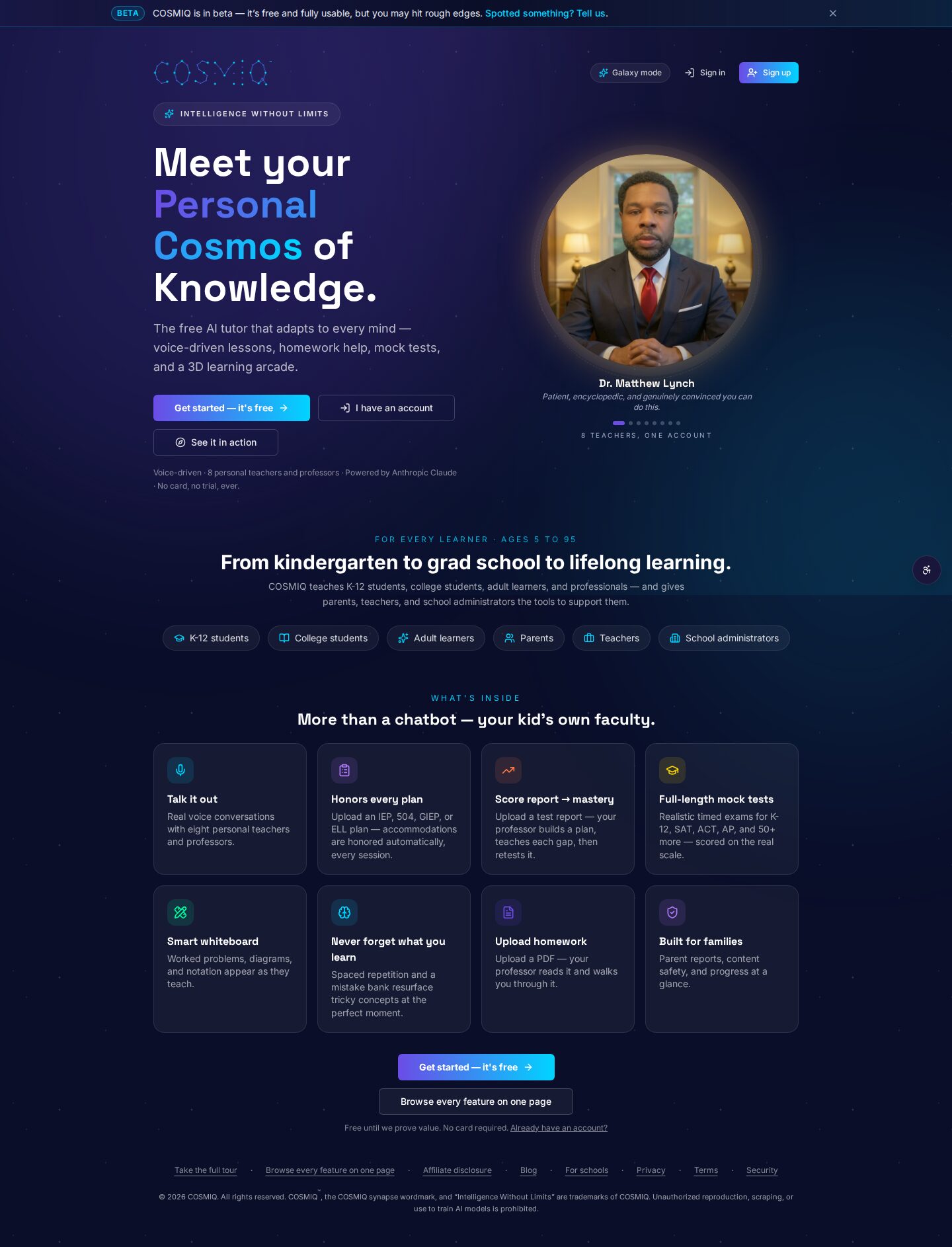
Platforms like COSMIQ, a free voice-driven AI tutor, can play a supportive role by helping students master foundational knowledge, thereby freeing up valuable classroom time for educators to focus on these higher-order human cognitive skills. Students can access free voice AI tutoring to solidify understanding in various subjects, allowing them to engage more deeply with complex, creative, and critical thinking challenges presented by their teachers.
Building Student Potential in an AI World
Otus's work suggests that the educational system has an opportunity to redefine how it identifies and develops student potential. Instead of solely measuring performance against metrics where AI now competes, educators can look for and nurture those distinct human cognitive strengths. This might involve new assessment methods that evaluate creativity, ethical reasoning, and the ability to synthesize information from diverse sources in innovative ways.
The organization's exploration serves as a positive affirmation of human capabilities in an age of advancing AI. It's a call to celebrate and cultivate the unique aspects of human intelligence that will remain indispensable. By understanding these differences, schools can intentionally design learning experiences that empower students to leverage AI as a tool while simultaneously developing their irreplaceable human talents. This forward-thinking approach ensures that education remains relevant and impactful, preparing students to thrive in a world where collaboration between human intelligence and artificial intelligence is increasingly the norm.
For students preparing for various academic hurdles, resources like COSMIQ's exam prep directory can be invaluable for mastering content, allowing them to focus their mental energy on developing the critical, creative, and adaptive thinking skills that Otus's findings highlight as uniquely human strengths.
Learn anything, free.
COSMIQ is a free, voice-driven AI tutor for every learner. No credit card, ever.
Start learning free →