An AI Tutor Aligned to the Oklahoma Academic Standards

The Evolution of Tutoring in Education
Think back to your school days. Remember that feeling of being lost in a subject? Math problems that just didn’t click? Or perhaps reading comprehension felt like deciphering ancient hieroglyphics? Tutoring has long been a lifeline for students struggling with the curriculum. But now, we’re at an exciting crossroads in education. Artificial Intelligence (AI) is stepping in, offering personalized learning experiences. And when aligned with the Oklahoma academic standards, this technology could be a game-changer.
AI tutors aren’t just a shiny new gadget; they represent a significant shift in how students can engage with their learning. Imagine having a tutor available 24/7, one who adapts to your pace, knows your strengths and weaknesses, and tailors lessons accordingly. That’s the power of an AI tutor. When designed to meet the Oklahoma curriculum, these tools can reinforce what students learn in the classroom while providing additional support.
Understanding the Oklahoma Curriculum
Before we dive deeper, let’s clarify what we mean by the Oklahoma curriculum and Oklahoma learning standards. Essentially, these guidelines lay out the educational framework for K-12 students across the state. They define what students should know and be able to do at each grade level. By sticking to these standards, educators ensure consistency and quality in education.
For instance, in mathematics, Oklahoma learning standards might require students in third grade to master multiplication and division. An AI tutor aligned with these standards would therefore focus on these skills, offering targeted practice problems and instant feedback. This alignment helps ensure that the tutoring experience supports classroom instruction, promoting confidence and mastery in subjects.
Furthermore, the Oklahoma curriculum is not static. It evolves based on educational research and changing societal needs. That means when an AI tutor is developed, it can be continuously updated to reflect new standards or methods. For instance, if inquiry-based learning becomes more emphasized in Oklahoma classrooms, AI tutors can incorporate that style of learning into their platforms, providing a richer educational experience.
How AI Tutors Work
Let’s get into the nitty-gritty of how these AI tutors operate. At their core, they use algorithms to analyze a student’s performance. They continuously track progress and adapt lessons based on results. If a student struggles with geometry but excels in algebra, the AI can focus more on geometry topics until the student shows improvement.
This adaptive learning is one of the key advantages of AI tutors. These systems can assess a learner’s needs in real time. If a student gets a question wrong, the AI can provide additional explanations or alternative problem-solving approaches. For example, if a sixth grader is struggling with the concept of fractions, the AI tutor can offer visual aids, interactive exercises, and real-world applications to help solidify understanding. It’s like having a personalized teaching assistant who knows you inside out.
Moreover, these AI systems can employ various teaching strategies, addressing different learning styles. Some students may benefit from visual aids, while others may find auditory explanations more effective. An AI tutor can deliver content in multiple formats. For instance, while explaining a scientific concept, it might show a video, provide a text explanation, and even offer a quiz to reinforce learning. This diverse approach can cater to a wider array of learners, making education more inclusive.
Benefits of AI Tutors in Oklahoma
So, why should schools and families in Oklahoma consider using AI tutors? The benefits are substantial. First, there’s accessibility. Not every student can afford a private tutor, but AI tutoring often comes at a lower cost. Many platforms offer subscription services that make them accessible to a wider audience.
Second, these tutors provide instant feedback. Unlike traditional methods where a teacher may take days to grade an assignment, AI gives immediate responses. If students are stuck, they don’t have to wait for the next class to get help. This immediacy can significantly enhance the learning process and build self-confidence.
Finally, an AI tutor can create a safe space for mistakes. Students may be hesitant to ask questions in front of peers, fearing judgment. With AI, they can make mistakes, learn from them, and try again without the pressure of a classroom environment. This element of risk-free learning can be particularly beneficial for Oklahoma students who might struggle with specific subjects.
Additionally, AI tutors can track long-term progress over time. Imagine a student starting in the fifth grade and continuing to use an AI tutor into middle school. The AI can maintain a comprehensive record of their strengths and weaknesses, adjusting the focus of future lessons based on their evolving needs. This level of tracking would be nearly impossible for a human tutor to replicate consistently.
Challenges and Considerations
Of course, incorporating AI tutors into the educational landscape isn’t without its challenges. One concern is the technology gap. Not all students have equal access to devices or reliable internet. For students in rural Oklahoma, these disparities can be significant. Schools need to address this to ensure every student can benefit from these advancements.
Another consideration is the role of the teacher. AI tutors should complement, not replace, traditional teaching. Educators play a crucial role in guiding students and fostering a love of learning. AI can assist by providing additional resources, but it can’t replicate the mentorship and support that a human teacher offers.
Moreover, there’s a potential concern about over-reliance on technology. If students become too accustomed to getting help from an AI tutor, they may not develop essential problem-solving skills. It’s vital that students still engage in critical thinking and learn how to tackle challenges on their own.
There’s also the matter of data privacy. With AI tutors tracking a student’s progress and learning habits, it’s crucial to ensure that this data is handled responsibly and ethically. Parents and schools need to be vigilant about who has access to student information and how it’s used, making transparency a key component of any AI tutoring program.
Real-World Applications in Oklahoma Schools
Several schools in Oklahoma are already testing AI tutoring solutions. For example, some districts have partnered with companies to pilot AI-driven platforms that align with the Oklahoma learning standards. Initial results show promise; students using these tools demonstrate improved test scores and retention rates.
Take a look at a local high school that implemented an AI math tutor. Teachers reported that students who used the tutor for just a few weeks showed a marked increase in their understanding of calculus concepts. This real-world application illustrates how effective these tools can be when aligned with established curriculum goals.
In another case, a middle school in Oklahoma City began using an AI reading tutor. Teachers observed that students who struggled with comprehension were able to engage with texts more deeply. The AI provided individualized reading passages, quizzes at varying difficulty levels, and suggestions for additional practice. The results were staggering: reading levels improved significantly, and students who once dreaded reading were actually looking forward to their sessions.
Additionally, special education programs are beginning to embrace AI tutors to meet diverse learning needs. By customizing lessons to fit individual learning plans, AI can provide targeted support for students with different abilities. This tailored approach can make a substantial difference in a student’s educational journey, ensuring that no one gets left behind.
Moving Forward with AI Tutors

As we look to the future, the potential for AI tutors in education continues to expand. Oklahoma’s commitment to refining its curriculum and educational standards means that these tools can evolve alongside them. Incorporating feedback from teachers, students, and parents will be crucial as schools integrate AI into their teaching methodologies.
The idea isn’t just to throw technology at students but to create a cohesive educational experience that enhances their learning journey. Think about it: with AI tutors tailored to the Oklahoma curriculum and standards, we could see a generation of students equipped with the skills and confidence they need to thrive.
Moreover, embracing these tools does not mean ignoring traditional teaching methods. A hybrid approach that fuses the benefits of AI with the personal touch of educators can create dynamic learning environments. For example, teachers can utilize AI data to identify which students need extra help and focus classroom time on collaborative projects that require critical thinking, while the AI handles more straightforward revision concepts.
Teacher Training and Professional Development
To effectively integrate AI tutors into Oklahoma classrooms, teacher training is essential. Educators need to be comfortable with the technology and understand how to interpret the data generated by AI platforms. Professional development programs should cover best practices for using AI tools and how they fit into the larger educational framework, focusing on the Oklahoma learning standards.
Imagine a summer workshop where teachers can actively engage with AI tutoring systems, exploring how to leverage these tools for their specific subjects. With hands-on training, educators can learn about the features of the AI platform and how to customize it to meet the needs of their students. They can then return to their classrooms with confidence, ready to enhance their teaching with AI support.
Additionally, ongoing support is crucial. Schools should establish mentorship programs where experienced educators can help newer teachers navigate the challenges of integrating AI into their classrooms. This collaborative approach can foster an environment of continuous improvement, ensuring that both educators and students make the most of the technology.
Finally, teachers should also be encouraged to provide feedback on AI tools. They are on the frontline, seeing what works and what doesn’t. Systems that can adapt based on teacher input will be more effective, as they’ll be tailored to the specific needs of Oklahoma students and the curriculum they must master.
Final Thoughts on AI in Education
The integration of AI tutors aligned to the Oklahoma academic standards is an exciting prospect. It offers the potential for personalized learning, immediate support, and increased accessibility. However, schools must continue to focus on equitable access and the essential role of teachers in guiding students.
As we embrace this innovative technology, let’s keep the conversation going. How can we ensure that every student benefits from these advancements? What steps can we take to further integrate AI into our educational frameworks? The answers to these questions will shape the future of education in Oklahoma, and it’s a future worth exploring.
Remember, education isn't just about passing tests. It’s about fostering a love for learning, building critical thinking skills, and preparing students for future challenges. With AI tutors, we stand on the brink of a new educational era — one that has the potential not only to change how students learn but also to reshape the entire educational landscape in Oklahoma.
Learn anything, free.
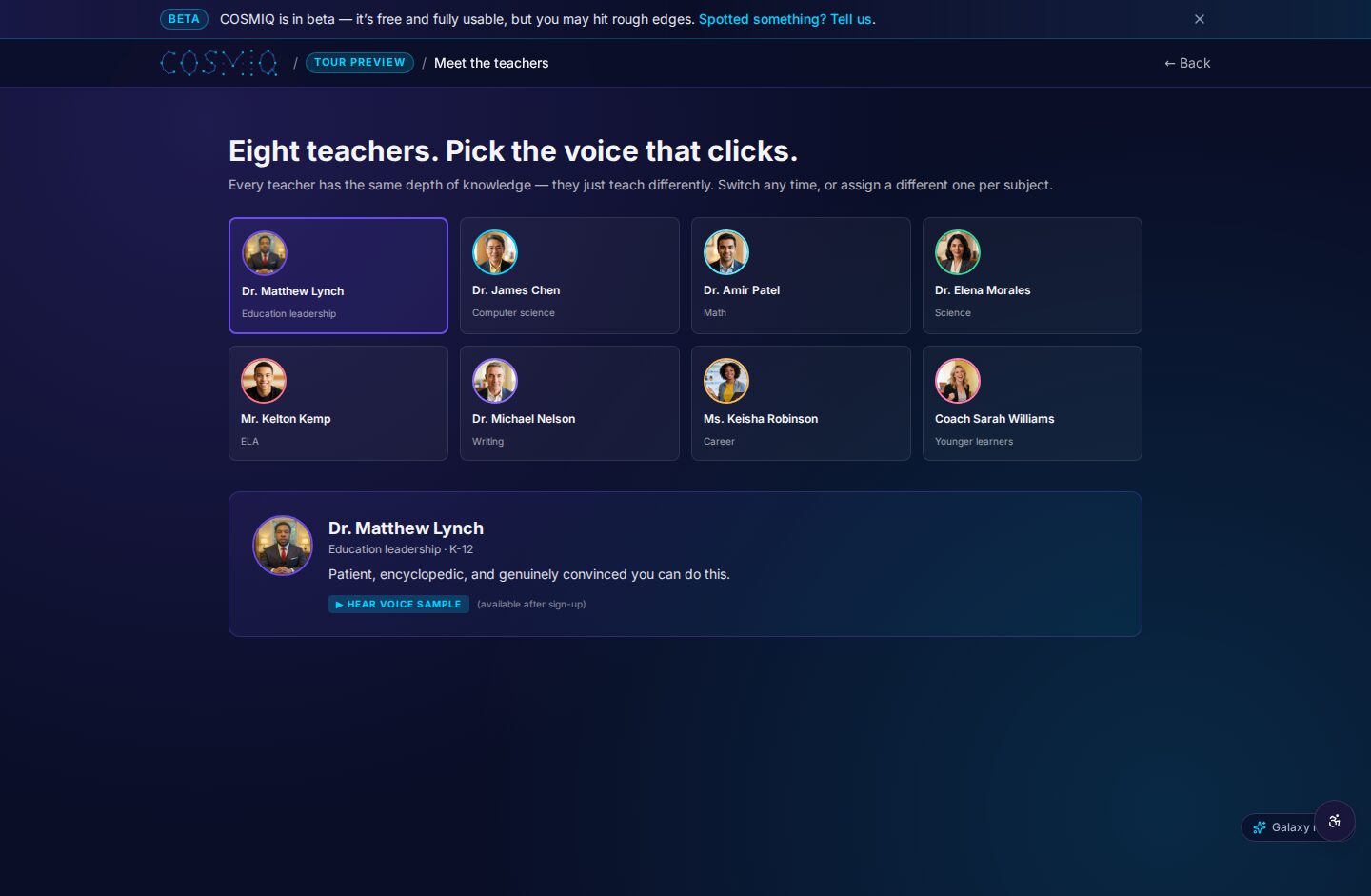
COSMIQ is a free, voice-driven AI tutor for every learner. No credit card, ever.
Start learning free →