OpenAI Reports Progress on a Second Millennium Prize Problem

In a significant development for the fields of artificial intelligence and mathematics, OpenAI has indicated it has made substantial progress on a second of the Clay Mathematics Institute's Millennium Prize Problems. This announcement, reported by The New York Times, follows the organization's earlier reported work on the Navier-Stokes existence and smoothness problem, one of seven famously difficult mathematical challenges, each carrying a $1 million prize for its solution.
While OpenAI has not yet publicly named the specific problem it has reportedly advanced, the news underscores the evolving capabilities of AI in addressing complex, long-standing scientific and mathematical hurdles. For students, educators, and parents, this brings into focus how advanced computational tools are changing the landscape of discovery and problem-solving.
The Millennium Prize Problems: A Quick Overview
The Clay Mathematics Institute established the Millennium Prize Problems in 2000, identifying seven fundamental mathematical questions whose solutions would mark profound advancements in various branches of mathematics. To date, only one—the Poincaré Conjecture—has been solved. The remaining six are:
- P vs NP Problem: A foundational question in theoretical computer science concerning whether every problem whose solution can be quickly verified by a computer can also be quickly solved by a computer.
- Hodge Conjecture: A problem in algebraic geometry that relates the algebraic topology of a non-singular complex projective variety to its algebraic subvarieties.
- Riemann Hypothesis: A conjecture about the distribution of prime numbers, considered one of the most important unsolved problems in pure mathematics.
- Yang-Mills Existence and Mass Gap: A problem in quantum field theory concerning the existence of quantum Yang-Mills theory and a "mass gap."
- Navier-Stokes Existence and Smoothness: This problem, which OpenAI previously reported progress on, deals with the mathematical understanding of fluid dynamics.
- Birch and Swinnerton-Dyer Conjecture: A problem in number theory concerning elliptic curves.
Solving any of these problems requires extraordinary insight, rigorous proof, and often, the development of entirely new mathematical techniques.
OpenAI's Approach: Computational Power Meets Mathematical Rigor
According to OpenAI, its reported progress on the Navier-Stokes problem involved an internal model, said to be significantly more capable than its GPT-6 Astra, which coordinated approximately 10,000 agents over 88 hours. This multi-agent system allowed for parallel exploration of mathematical approaches and shared promising paths, culminating in a proposed solution and a formal proof in Lean, a formal proof assistant.
This method highlights a crucial aspect of AI's potential in mathematics: checkability. By using formal verification systems and allowing numerous agents to explore and test hypotheses, AI can accelerate the process of discovering and validating proofs. This turns sheer computational power into a tool for achieving verifiable results, potentially tackling problems that have eluded human mathematicians for decades.

While the specific second problem remains unnamed by OpenAI, rumors, as noted by Andrew Curran, suggest it might be the Hodge Conjecture. OpenAI has not confirmed this detail or the speculative name 'Aeon' for the unreleased model.
Implications for Education and Research in 2026
The reported advancements by OpenAI carry significant implications for how we approach education and research:
-
Rethinking Problem-Solving: Students and educators might increasingly integrate AI tools into their problem-solving processes, not just for computation, but for exploring complex logical structures and generating hypotheses.
-
Emphasis on Formal Verification: The use of formal proof assistants like Lean underscores the growing importance of rigorous, verifiable mathematical proofs, a skill that could see renewed emphasis in advanced mathematics education.
-
Interdisciplinary Learning: These breakthroughs demonstrate the powerful synergy between computer science, AI, and pure mathematics, encouraging more interdisciplinary approaches in academic curricula.
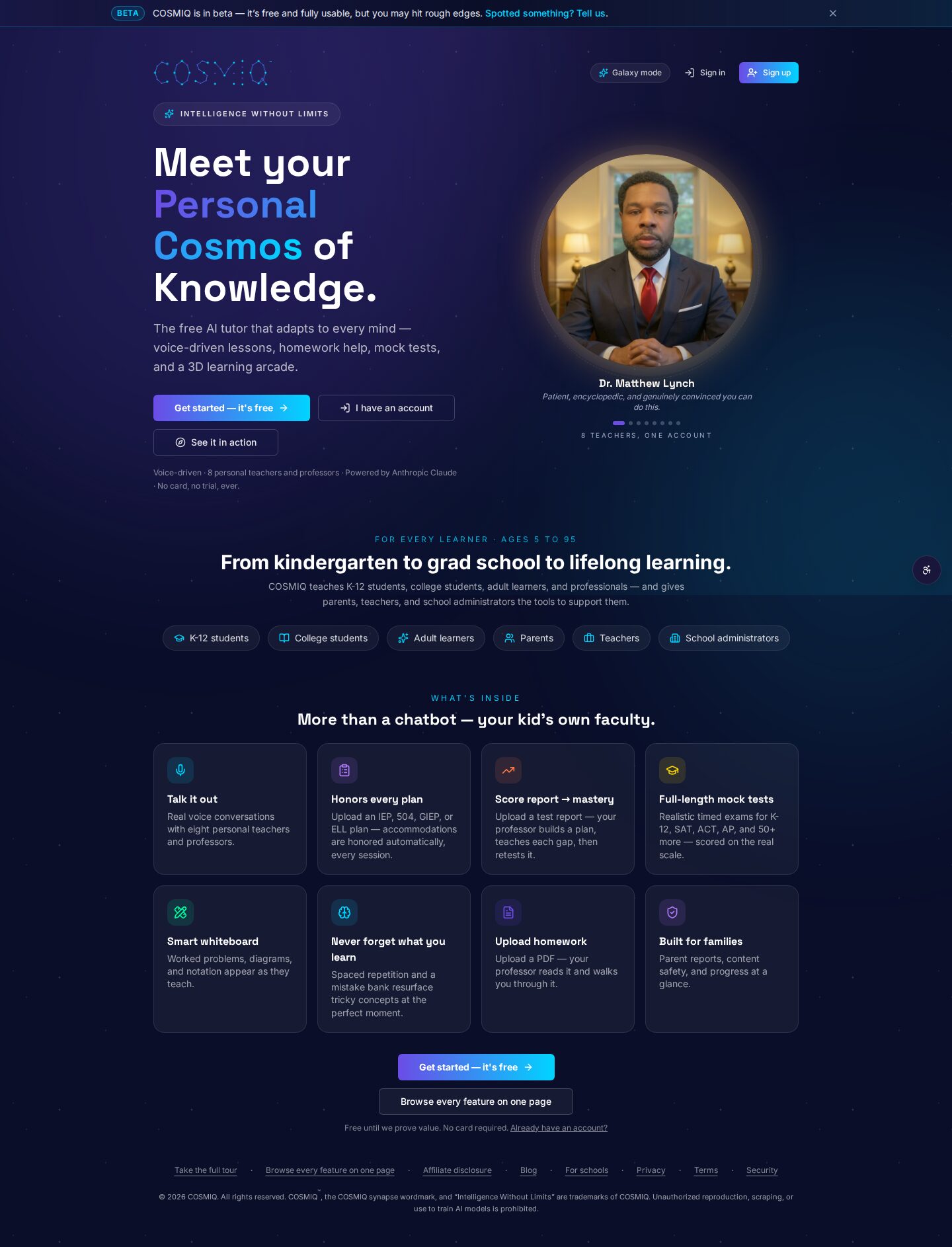
For learners navigating challenging subjects, platforms like COSMIQ offer free, voice-driven AI tutoring that can help demystify complex concepts and support their learning journey. Whether it's understanding advanced mathematical principles or preparing for exams, COSMIQ is available to every K-12 student, free forever.
The Path Ahead: Independent Review and Verification
The true measure of these reported breakthroughs will lie in their independent review and verification by the broader mathematical community. As OpenAI notes, the proposed Navier-Stokes solution and its proof in Lean await scrutiny. The ability of OpenAI to consistently repeat such successes across unrelated problems, with verifiable research output, would indeed signal a stronger capability than mere leaderboard scores.
This ongoing narrative of AI's increasing role in fundamental research is a testament to human ingenuity and technological advancement. It invites us all to consider the new frontiers of knowledge that are becoming accessible, and how we can prepare the next generation of thinkers and innovators to engage with these powerful tools.
Students looking for more resources to master their subjects can explore COSMIQ's free practice hub by grade and subject, offering valuable support across a wide range of topics.
Learn anything, free.
COSMIQ is a free, voice-driven AI tutor for every learner. No credit card, ever.
Start learning free →