Schools Are Writing AI Rules Before Knowing the Destination

Schools are being asked to make decisions about artificial intelligence at an uncomfortable speed. Families want clarity, teachers need workable expectations, and students are already encountering AI tools in search engines, writing apps, study platforms, and social media. Yet no one can say with confidence exactly how these tools will fit into learning over the long term. That leaves many schools writing rules before they know the destination.
That is not necessarily a failure of planning. It is a realistic response to a moving target. The goal is not to produce a perfect, permanent AI policy. It is to establish clear guardrails, protect students, and create a process for learning and revising together.
Why schools cannot wait for complete certainty
Waiting until AI is fully understood may sound sensible, but it can create a vacuum. In the absence of shared guidance, each classroom may develop different expectations. Students may be unsure whether using AI for brainstorming, translation, feedback, or practice is allowed. Teachers may spend too much time investigating suspected misuse rather than teaching. Parents may hear conflicting messages about what responsible use looks like.
A useful early policy does not need to predict every future tool. It should answer the questions people face today: What kinds of AI use support learning? What use must be disclosed? What work must remain a student’s own? What information should never be entered into a public tool? Who can help when a situation is unclear?
Schools should also resist treating AI as only an academic-integrity problem. Generative AI can make it easier to submit work a student did not create, but it can also support practice, accessibility, language development, feedback, and idea generation. A policy that only says “do not use AI” may be simple to announce, yet difficult to apply and limited as a teaching approach.
Build principles before making a long list of rules
Because tools change quickly, broad principles tend to last longer than tool-by-tool bans. They give teachers and students a way to make reasonable decisions when a new app appears or an assignment changes.
Consider a small set of principles such as these:
- Learning comes first. AI should help students think, practice, revise, and understand—not replace the thinking an assignment is designed to assess.
- Human responsibility remains central. Students are responsible for checking accuracy, making choices, citing permitted assistance, and standing behind submitted work.
- Transparency matters. When AI use is allowed and materially shapes an assignment, students should explain how they used it.
- Privacy is non-negotiable. Students and staff should not enter sensitive personal, academic, health, or school information into unapproved tools.
- Access should be fair. Expectations should not depend on who can pay for premium software, has faster internet, or receives outside help.
- Adults must teach the skill. Responsible AI use is learned through modeling, discussion, and practice, not through a one-page warning alone.
These principles make room for professional judgment. A teacher may permit an AI tutor for extra practice while requiring students to solve an assessment independently. Another teacher may allow feedback on a draft but ask students to attach a brief note describing which suggestions they accepted or rejected.
Turn principles into classroom routines
Students need more than a policy posted on a website. They need concrete examples. One practical approach is to label assignments by the kind of AI use permitted. The labels can be simple and consistent across a school or department.
- AI not permitted: The task is intended to show independent thinking or skill performance. Students may use only the resources named by the teacher.
- AI permitted for limited support: Students may use AI for defined purposes, such as generating practice questions, checking grammar, translating a word or phrase, or receiving feedback. They must still complete the core work themselves.
- AI use encouraged with disclosure: The assignment includes learning how to prompt, evaluate, compare, revise, or critique AI output. Students document their process.
For disclosure, keep the requirement proportionate. A simple statement can be enough: “I used an AI tool to suggest practice questions. I checked the answers against my class notes and wrote my own responses.” For larger projects, students might submit prompts, selected outputs, and a reflection on errors, bias, or changes they made.
Assessment design matters too. Teachers do not need to abandon essays, homework, or take-home projects. They can gather more evidence of learning across time: quick conferences, annotations, draft histories, oral explanations, in-class writing, problem-solving demonstrations, and short reflections. These methods often improve feedback even when AI is not involved.
Include students, families, and teachers in the revision process
Policies work better when they are understandable to the people expected to follow them. Invite students to discuss realistic scenarios: Is it acceptable to ask an AI tool for a study plan? To summarize a chapter they did not read? To improve a sentence? To generate a first draft? The value of these conversations is not that every answer is identical. It is that students learn to explain their reasoning and recognize boundaries.

Families also need plain-language communication. Explain what the school permits, what it does not permit, how privacy is handled, and how parents can talk about AI at home. Avoid assuming that every family knows what generative AI does or has access to the same tools.
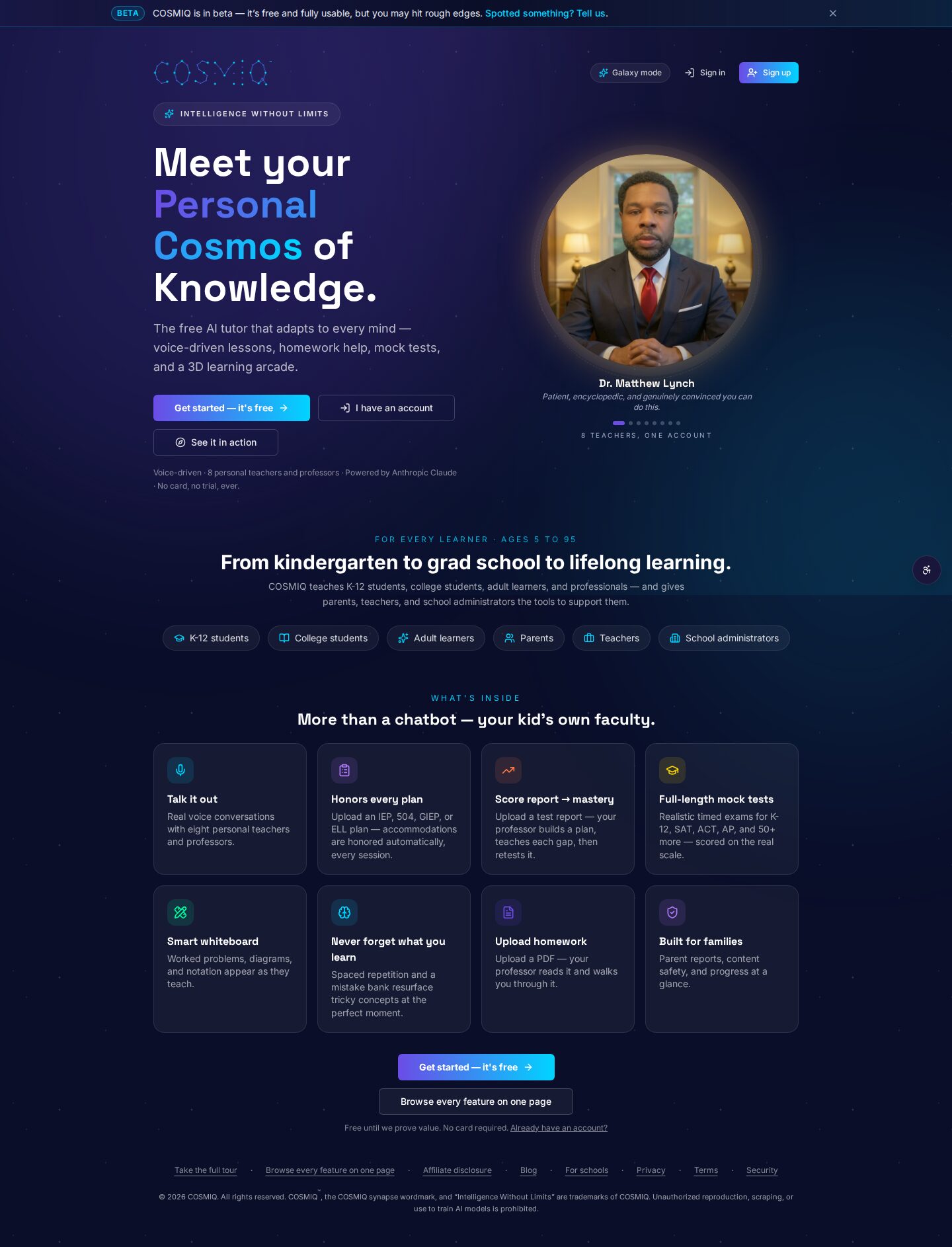
Teachers need time and support, not just a directive. Useful professional learning can include trying approved tools, examining flawed outputs, designing AI-aware assignments, and agreeing on how to address misuse consistently. A voice-driven AI tutoring platform such as COSMIQ can also be discussed as a learning support: students can use guided conversation to explain a concept, rehearse reasoning, or practice questions, while teachers still set the boundaries for assigned work.
Finally, give the policy a review date. A short statement that will be revisited during the 2026-2027 school year is more honest and useful than a document that implies finality. Track recurring questions, classroom challenges, privacy concerns, and examples of effective practice.
Choose clarity over false certainty
Schools do not need to know the final destination to set a responsible direction. The strongest AI rules are clear enough to guide daily choices, flexible enough to evolve, and grounded in what education is for: helping young people build knowledge, judgment, independence, and integrity. When policies are treated as living guidance rather than fixed verdicts, schools can respond to change without losing sight of learning.
Learn anything, free.
COSMIQ is a free, voice-driven AI tutor for every learner. No credit card, ever.
Start learning free →