Virginia Tech Experts Champion Responsible AI Use for K-12 Students

As artificial intelligence (AI) continues to weave itself into the fabric of daily life, its presence in K-12 classrooms has become a significant topic of discussion. Rather than viewing AI solely through the lens of potential misuse, experts from Virginia Tech are advocating for a proactive approach: teaching students to engage with AI responsibly and critically. This perspective, shared by Amy Allen and Pamela Gilchrist, offers a valuable framework for students, parents, and educators navigating the evolving landscape of educational technology.
According to Virginia Tech, the focus should move beyond simply detecting AI-generated content to empowering students with the judgment and skills to use these powerful tools effectively and ethically. This shift acknowledges that AI is already a part of students' lives and that schools have a vital role in guiding its responsible integration into learning.
Embracing 'Technocuriosity' in the Classroom
Amy Allen, an associate professor of history and social science in Virginia Tech's School of Education, champions an approach she developed with colleague David Hicks called "technocuriosity." As Allen explains, "Technocuriosity encourages educators, parents, and students to approach AI with disciplined curiosity." This means actively exploring AI's capabilities and limitations, understanding its biases, and making thoughtful decisions about when it genuinely supports learning.
Allen emphasizes that responsible AI integration also involves knowing "when to not use AI." She suggests that instead of expending most energy on catching students in misuse, educators should focus on developing students' judgment. "Schools have always helped students learn to navigate new technologies, from search engines to social media. AI belongs in that same conversation," Allen states, according to Virginia Tech.
Pamela Gilchrist, director of K-12 initiatives at Virginia Tech, echoes this sentiment, asserting that AI is a foundational skill students should master. She notes that students already encounter AI through various platforms, making avoidance impractical. "The role of schools is to help students understand when AI is useful, when it is inappropriate, and how to use it without losing the ability to think independently," Gilchrist says.

Redesigning Assignments for an AI-Integrated World
The rise of AI tools presents an opportunity for educators to rethink curriculum and assignment design. Allen suggests moving away from assignments that rely on generic summaries and towards tasks that require students to explain their reasoning, justify decisions with evidence, and evaluate AI-generated responses critically alongside other sources.
"Students should first have opportunities to notice, wonder, struggle, and develop their own ideas before AI enters the conversation," Allen advises. This approach, she explains, preserves curiosity while allowing AI to serve as a scaffold that extends thinking rather than replacing it. Gilchrist adds that teachers can incorporate strategies like asking for drafts, discussing the student's process, or completing portions of assignments in class. "The goal is not simply to catch students – it is to help them understand ownership, honesty, and why their own effort still matters," Gilchrist states, according to Virginia Tech.
AI as a Learning Partner: The "Ask. Check. Create. Explain." Framework
Both Virginia Tech experts view AI as most effective when it supports learning rather than replaces it. Allen encourages teachers to think of AI "as a conversation partner or mentor rather than an answer machine."
Gilchrist recommends a practical framework for responsible AI use: "Ask. Check. Create. Explain." This approach is actively incorporated into the Virginia Tech K-12 Innovation Lab's programming in Alexandria. In this framework, students:
- Ask AI for support.
- Check whether the AI's response is accurate.
- Create their own work.
- Explain what they learned and how AI was used in tasks like programming sensors, robots, and drones.
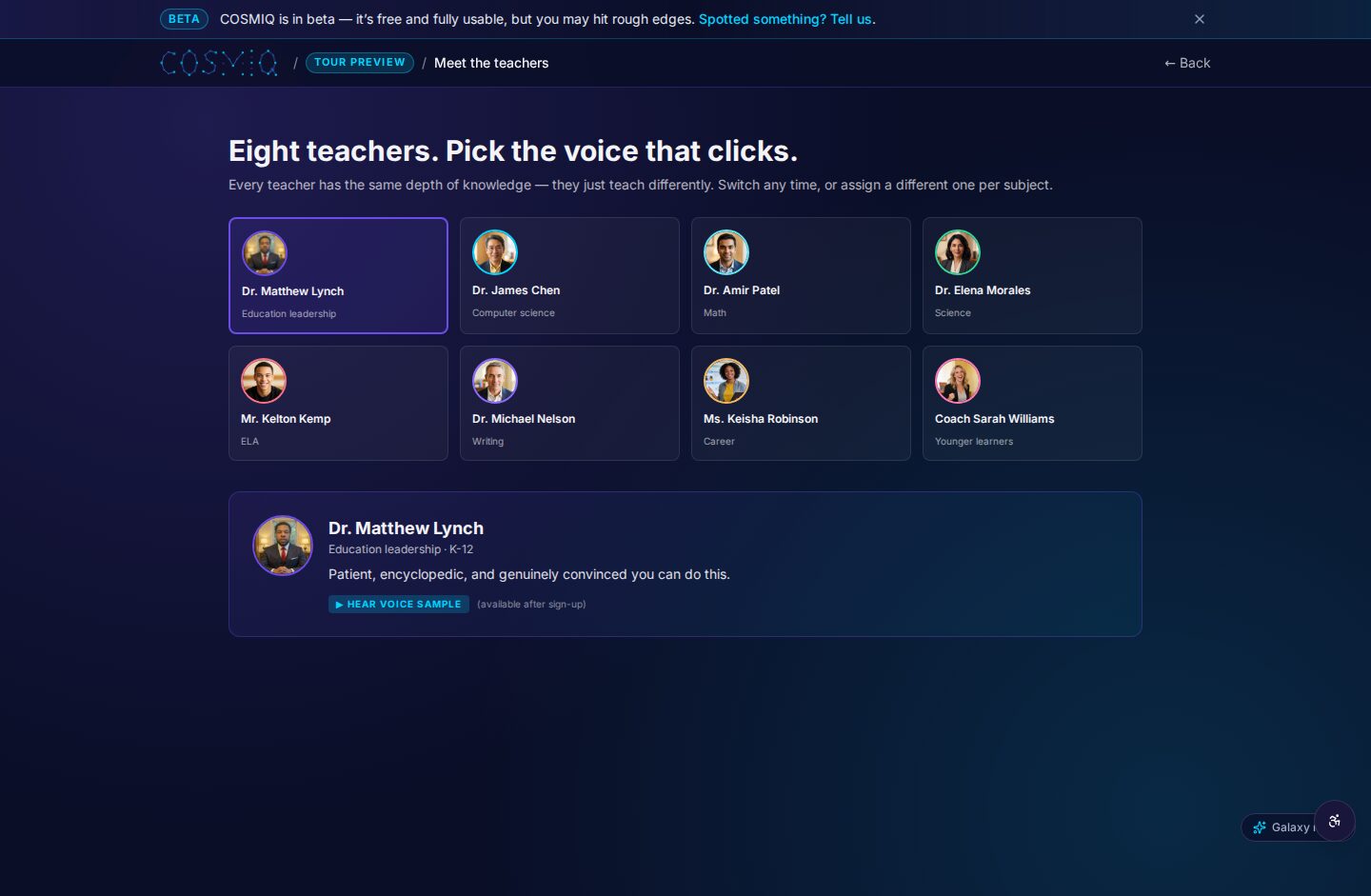
This method highlights AI's potential to enhance understanding and skill development, rather than merely providing answers. For K-12 students seeking additional free, voice-driven AI tutoring support across subjects, platforms like COSMIQ can serve as a valuable tool to practice skills, understand difficult concepts, and receive feedback, aligning with the idea of AI as a learning partner. Students can also explore the free practice hub by grade and subject at COSMIQ's practice hub to reinforce their learning.
As AI tools continue to evolve, Allen and Gilchrist emphasize the enduring importance of skills that transcend any single technology. "AI becomes valuable when it helps students understand difficult concepts, practice skills, organize ideas, and receive feedback," Gilchrist explains. "It becomes a problem when it replaces reading, writing, problem solving, creativity, or genuine understanding. The measure that matters is whether a student walks away more capable and confident – not whether the tool was used at all."
Virginia Tech's Commitment to Educational Innovation
The insights from Amy Allen and Pamela Gilchrist underscore Virginia Tech's commitment to preparing students, educators, and families for a future where AI is an integral part of learning and life. Through their research and K-12 initiatives, they are helping to shape a thoughtful, ethical, and effective approach to integrating AI into education. Allen's forthcoming book, "Teaching History with Chatty Geeps," co-written with David Hicks, will further contribute to this effort as a free online educational resource from Virginia Tech Publishing and Press.
By focusing on critical thinking, responsible use, and innovative assignment design, Virginia Tech experts are providing actionable strategies that can empower K-12 students to harness the power of AI to become more capable and confident learners.
Learn anything, free.
COSMIQ is a free, voice-driven AI tutor for every learner. No credit card, ever.
Start learning free →